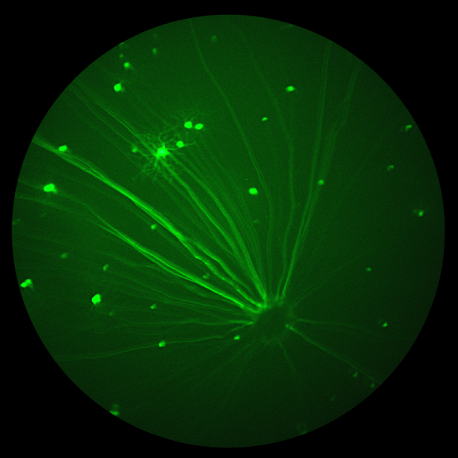
In April 2025, we announced the MICRON Image-Guided 810 nm Laser system with the ability to induce geographic atrophy in rodents. Today I’m happy to announce that the system has started shipping to researchers, and the final product includes three laser modes: continuous wave, long pulse, and short pulse. In this blog post we provide some background on how we approached designing the product, and its applicability to AMD research.
Geographic atrophy (GA) represents one of the most challenging areas in vision research today. As the advanced stage of dry age-related macular degeneration (AMD), GA causes progressive and irreversible vision loss through the gradual death of retinal pigment epithelium cells and photoreceptors in the macula. Understanding this disease process requires robust preclinical models that can accurately replicate the pathology observed in human patients 1, 2, 3.
The Challenge of Modeling Geographic Atrophy
Dry AMD affects approximately 80-90% of all AMD cases, approved treatments specifically for GA are few. Even with recent therapeutic approvals, current interventions can only slow disease progression—they cannot stop or reverse the damage. This reality underscores the critical need for research tools that enable scientists to study GA mechanisms and test potential interventions in controlled laboratory settings.
The fundamental challenge lies in creating reproducible models of retinal degeneration. Researchers need to induce controlled lesions that mimic the progressive atrophy seen in human disease while maintaining the ability to monitor changes over time. Traditional methods have often lacked the precision or documentation capabilities needed for rigorous longitudinal studies.
Image-Guided Laser Technology for Retinal Research
Near-infrared lasers operating at approximately 810 nm wavelengths offer a targeted approach to inducing retinal lesions in rodent models 4, 5. This wavelength selectively penetrates and affects the RPE-choroid complex while minimizing impact on surrounding retinal structures. This selectivity is crucial for creating lesions that model the targeted cell death characteristic of GA.
The integration of image guidance with laser delivery available with the MICRON® retinal imaging system for small animal research, addresses several technical limitations that have historically complicated retinal laser studies. Real-time visualization during treatment allows researchers to precisely target specific retinal locations and immediately observe tissue response. The shared view also allows mentors to observe and guide trainees as they perform the method. This capability transforms laser photocoagulation from a somewhat imprecise technique into a documented, reproducible experimental method.
Stabilization and Documentation
One technical advantage of the MICRON Image-Guided laser system involves the use of gel coupling between the cornea and MICRON objective lens. This approach stabilizes the eye against respiratory movements, which can introduce variability in laser delivery. And, the gel interface maintains corneal hydration throughout the procedure, reducing the risk of media opacification that could interfere with both treatment and subsequent imaging. In addition, coupling the laser delivery system directly to the eye contains the laser energy, eliminating stray light in the laboratory environment.
The ability to capture high-quality images and video before, during, and immediately after laser treatment as well as tag and annotate images, provides comprehensive documentation of each experimental intervention. This documentation becomes particularly valuable in longitudinal studies tracking GA progression over days or weeks following the initial lesion induction.
Integration with Optical Coherence Tomography
Pairing laser delivery systems with optical coherence tomography (OCT) imaging creates a powerful workflow for GA research. OCT provides cross-sectional views of retinal structure, allowing researchers to confirm the depth and extent of laser burns immediately after treatment. This same imaging modality can then track structural changes over time, documenting how the initial lesion evolves into an atrophic area that models human GA progression.
The ability to switch between laser delivery and OCT imaging within a single session means researchers can establish baseline measurements, deliver precisely calibrated laser energy, confirm the immediate tissue response, and plan follow-up imaging sessions with confidence that they can relocate and assess the same retinal areas.
Flexible Multi-Mode Delivery for Different Research Protocols
Different research questions may require different laser delivery parameters. A continuous wave laser provides sustained energy delivery, while a short pulse laser offers controlled energy bursts, and a long-pulse mode provides options to titrate laser energy delivery. The availability of these operating modes in one laser allows researchers to structure their protocols based on specific experimental goals with a single laser system—whether inducing acute lesions, studying dose-response relationships, or modeling different aspects of retinal injury and repair and therapy.
The 810 nm laser delivers comparable maximum power output (up to 2 W) with wavelength precision (808nm ± 5nm), ensuring consistency across different experimental setups. Separate objective lenses for mice and rats accommodate anatomical differences between species, extending the range of possible experimental models.
The Path Forward
At Phoenix-Micron we will continue to innovate new imaging modalities to induce disease models and capture high quality images, video, and data. The efficient integration of multiple imaging modalities on a unified platform, like the MICRON system, enables comprehensive, longitudinal studies that capture the full complexity of retinal disease. As these tools become more accessible to research laboratories, our collective understanding of GA pathophysiology will deepen, bringing us closer to the therapeutic breakthroughs that patients desperately need.
References:
- “Geographic atrophy: Mechanism of disease, pathophysiology, and management.” PMC. February 23, 2023. Available at: https://pmc.ncbi.nlm.nih.gov/pmc/articles/PMC9975689/
- “Geographic Atrophy (GA).” Apellis Pharmaceuticals. March 31, 2025. Available at: https://apellis.com/geographic-atrophy-ga/
- “Geographic Atrophy: The Advanced Form of Dry AMD.” Fighting Blindness. April 18, 2023. Available at: https://fightingblindness.org/geographic-atrophy-dry-amd/
- Khan, A. H., Soundara Pandi, S. P., Scott, J. A., Sánchez-Bretaño, A., Lynn, S. A., Ratnayaka, J. A., Teeling, J. L., & Lotery, A. J. (2023). A laser-induced mouse model of progressive retinal degeneration with central sparing displays features of parafoveal geographic atrophy. Scientific Reports, 13, 4194. DOI: 10.1038/s41598-023-31392-3
- Ibbett, P., Goverdhan, S. V., Pipi, E., Chouhan, J. K., Keeling, E., Angus, E. M., Scott, J. A., Gatherer, M., Page, A., Teeling, J. L., Lotery, A. J., & Ratnayaka, J. A. (2019). A lasered mouse model of retinal degeneration displays progressive outer retinal pathology providing insights into early geographic atrophy. Scientific Reports, 9(1), 7475. DOI: 10.1038/s41598-019-43906-z.
— For researchers interested in technical specifications or validation data, detailed information is available through Phoenix-Micron (phoenixmicron.com)