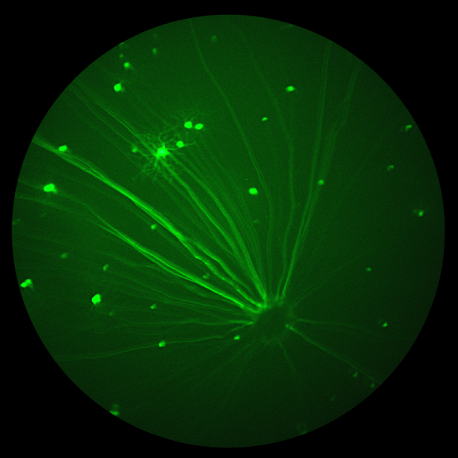
This year’s MICRON platform release focuses on three things that matter to your data: capturing image content that single-exposure imaging cannot capture, lowering the noise floor on small-signal measurements, and making the published literature in your field easier to find.

Highlights…
MICRON 5:
- HDR imaging for MICRON 5 that holds detail in both the bright and dim structures of a single retinal scene
- Focus stacks that improving imaging of features with depth (tumors, lesions, elevated optic nerve pathology)
OCT with MICRON Software Suite:
- Motion-corrected averaging for sharper layer boundaries and improved inputs to your segmentation and thickness workflows
810nm Laser:
- Software-controlled laser operation, including setting laser power and burn duration, with settings captured as image metadata
ERG:
- New control electronics for improved signal-to-noise
For all researchers:
- MICRON reSEARCH, our free, preclinical ophthalmology-focused literature database
Come see these new products at ARVO 2026 in Denver, May 3- 7, in booth 7003.
MICRON Software Suite: four new capabilities
MICRON Software Suite (MSS) is the application that runs MICRON IV (2021 and newer), MICRON 5, and MICRON SE. Four new features are landing in MSS this season. Two of them are MICRON 5 only because they depend on capabilities that exist only in the MICRON 5 architecture, and two apply more broadly. We will call out which is which.
HDR imaging (MICRON 5)
Some retinal scenes have more dynamic range than a single exposure can capture. The optic nerve head saturates while the periphery sits in shadow. A bright fluorescein-filled vessel washes out the capillary bed next to it. A lightly pigmented animal pushes the camera toward the bright end of its range and loses fine structure.
MSS now solves this by capturing multiple exposures of the same scene, varying gain, illumination, or aperture between captures, and combining them into one HDR image. You stop choosing between losing the disc and losing the periphery. You get both.
Focus stacks (MICRON 5)
Single-plane imaging flattens features that have real depth. Tumors, large CNV lesions, drusen, and elevated optic nerve head pathology all live across multiple focal planes, and a single image will only ever sharpen one of them.
MSS now captures images at multiple focal planes at the same retinal position and combines them into a single image with extended depth of field. Combined with the MICRON 5’s adjustable aperture, which already gives you per-shot depth-of-field control, you can image features with depth in full focus rather than slice by slice.
Why these features are MICRON 5 only
HDR and focus stacks are only possible because the MICRON 5 puts the camera, the illumination, and the aperture under software control. MICRON IV does not have that. We are building imaging capabilities enabled by software control of the MICRON 5 camera, and these are two of them.
If you are running a MICRON IV (2021 or newer) and these capabilities would change what you can measure, we have a trade-in program for the upgrade to MICRON 5. Talk to us about it.
Motion reduction in OCT averaging (MSS OCT users)
Averaging is the standard way to reduce speckle noise in OCT, but subject motion blurs the result. Even under sedation, breathing and small eye drifts will smear an averaged scan and degrade the layer boundaries you need for segmentation.
MSS now corrects for motion before averaging. The result is sharper layer boundaries and more reliable inputs to the segmentation and thickness measurement workflows you run across RNFL, GCL, IPL, INL, OPL, ONL, and RPE. This complements the AI/ML OCT segmentation tools that already ship with MSS.
This feature is available to every OCT user running MICRON Software Suite. That covers MICRON IV (2021 and newer), MICRON 5, and MICRON SE.
Software control of the MICRON Image-Guided 810 nm Laser (new purchases)
Until now, 810 nm laser power and duration were set on the laser controller, and those settings were not part of the image record. New 810 nm laser systems ship with software control built in. MSS sets power and duration directly and writes those values into the image metadata at capture time.
Two practical benefits. First, one source of lesion-to-lesion variability is removed, because power and duration are set in software and recorded with the image, rather than set on a separate controller. Second, your methods sections get cleaner, because the exact parameters are recorded with each image and exportable from MSS. For labs running geographic atrophy models with the 810 nm system, this matters.
A new ERG platform
Small-signal electrophysiology lives or dies on signal-to-noise. We have rebuilt the ERG platform from the controller out.
New Image-Guided Focal ERG and MICRON Ganzfeld systems now ship with new control electronics, new firmware, and a new head-stage. The head-stage pre-conditions the signal close to the animal, before the cable run. Smaller signals come through cleaner. Cable management on a busy ERG bench is simpler.
Existing CLEAN 60 Hz noise filtering, S-cone, M-cone, and rod-specific stimulus control on the Ganzfeld, and image-guided focal stimulus targeting on the Focal ERG all continue to work the way you expect. The new electronics are about lowering the noise floor, not changing the experiment.
This applies to new ERG purchases. If you are specifying ERG for a new lab, a new study, or a system replacement, this is what ships now.
MICRON reSEARCH: free literature search for the community
We announced MICRON reSEARCH earlier this month and will demo it live at ARVO. It is a curated, searchable collection of peer-reviewed papers from preclinical ophthalmic and neuroscience research conducted with MICRON imaging platforms, assembled from Europe PMC, PubMed, and OpenAlex.
It is free. Search and abstracts will require no account. Filter papers by animal model, disease profile, MICRON product, imaging modality, author, and institution, instead of wading through clinical results and unrelated instrumentation. Registered users at academic and research institutions get advanced filtering, saved searches, and citation export.
reSEARCH debuts at ARVO 2026, with full availability to all users following the close of the meeting. We will be running live demos at booth 7003 throughout the show.
What we are showing at booth 7003:
- MICRON 5 with the new MSS features running live: HDR, focus stacks, motion-reduced OCT averaging, and software-controlled 810 nm laser
- MICRON SE, our entry-level color fundus and GFP camera, on the same MSS workflow
- The full add-on modality lineup: Image-Guided OCT2, Image-Guided 810 nm Laser, Image-Guided 532 nm Laser, MICRON Ganzfeld, Image-Guided Focal ERG, and Slit Lamp
- The new ERG control electronics and head-stage
- The OptoDrum from Striatech, for which Phoenix-Micron is the exclusive North American distributor
- Live demos of MICRON reSEARCH
If one of these updates maps to a study you are planning, reach out before ARVO and we will set aside time at booth 7003.
See you in Denver.
About Phoenix-Micron
Phoenix-Micron, Inc. (PMI) designs and manufactures preclinical ophthalmic imaging instruments for in vivo small animal research. MICRON imaging systems are used by hundreds of research institutions in over 25 countries to study retinal disease, gene therapy, neuroscience, and more. PMI is headquartered in Bend, Oregon, with European operations based in Valencia, Spain through PMI Europe SL.
Request a quotation | Spec sheets and articles| MICRON reSEARCH