
Zum Inhalt springen
Phoenix Logo
  • PRODUKTE
    • Kameras
      • MICRON 5
      • MICRON SE
      • Hilf mir bei der Auswahl
    • MODALITÄTEN
      • Überblick
      • Image-Guided OCT2
      • Bildgesteuerter Laser
      • Ganzfeld ERG
      • Bildgesteuertes Focal ERG
      • Slit lamp
    • Software
      • MICRON® Review Station
      • MICRON® Software Suite
    • ZUBEHÖR
      • Animal Stand Pro
      • MICRON Tactile Plus Handschuh-Liner
      • Fluoreszierende Bildgebungsfilter
    • Optomotor Response
      • OptoDrum
      • Keratometer
      • Photorefactor
  • BEISPIELBILDER
  • ÜBER UNS
  • KONTAKT
    • FRAGEN
    • Fordern Sie ein Angebot an
    • Technischer Support
    • EINE BESTELLUNG SENDEN
  • PORTAL & eStore
  • BLOG & NACHRICHTEN
  • Deutsch
28.03
2024

Your Guide to Navigating Seattle for ARVO 2024

By Phoenix-Micron Team In ARVO, Nicht kategorisiert Tags ARVO 2024
Your Guide to Navigating Seattle for ARVO 2024

We’re excited to see everyone at ARVO 2024 in Seattle in May! Every year, we are impressed and humbled by the incredible presentations and posters that highlight breakthrough research related to new disease models, diagnostics, and therapies. Phoenix-Micron is headquartered in the Northwest, and many of our team members are either from the Seattle area […]

Read More

Suche

Ausgewählter Artikel

Subretinal injection damage has implication for experimental control and treatment in rat model of retinopathy of prematurity

In their 2017 article, “Effect of subretinal injection on retinal structure and function in a rat oxygen-induced retinopathy model,” Becker et al used the Phoenix MICRON IV fundus camera, Phoenix MICRON OCT2 and corresponding layer analysis software Insight 2D, and the Phoenix MICRON focal ERG to find that subretinal injection of saline or even introduction of a needle into the vitreal space has a detrimental effect on a rat model of retinopathy of prematurity. In normal adult rats, there is no effect of subretinal injections (results in other species vary) so these rats with oxygen-induced retinopathy may be more sensitive to damage.

Read more »

Aktuelle Beiträge

  • What’s new for MICRON at ARVO 2026
  • We’ll See You in Denver! ARVO 2026 – The Phoenix-Micron Guide to the Mile High City
  • Introducing MICRON reSEARCH
  • MICRON Systems Are Coming to Europe… Here’s What That Means for Your Lab.
  • MICRON® Review Station: Take Your Image Review Out of the Lab

Schlagwörter

Alzheimers Forschung AMD Auge-Gehirn-Forschung Augenforschung Bissverletzung Choroidale Neovaskularisation (CNV) CNV Degenerative Erkrankung diabetische Retinopathie ERG eStore FA Fluoreszeinangiographie Fundusbild Ganzfeld Ganzfeld ERG Glaukom Handschuhe Hornhautwunde InSight Künstliche Intelligenz Laser längs Makuladegeneration Mausmodell MICRON IV MICRON OCT Netzhaut Netzhautbilder Netzhautdegeneration Netzhautgefäße Netzhautstruktur OCT OCT2 optische Kohärenztomographie Phoenix MICRON Phoenix MICRON IV Phoenix Micron OCT Retinale Ganglienzellen (RGC) retinales Pigmentepithel Retinitis Pigmentosa RPE Trockene AMD Uveitis Zebrafisch

Benötigen Sie weitere Informationen? Kontakt

  • Angebot anfordern
  • Technischer Support
  • Allgemeine Frage
Phoenix-Micron, Inc
543 NW York Drive, Suite 100, Bend, OR
97703, USA
Tel: +1-541-668-7539

Kameras

  • MICRON 5
  • MICRON SE
  • Helfen Sie mir bei der Auswahl

Modalitäten

  • Überblick
  • Bildgesteuerte OCT2
  • Bildgesteuerter Laser
  • Ganzfeld ERG System
  • Bildgesteuertes Focal ERG
  • Slit Lamp

die Software

  • MICRON® Review Station
  • MICRON® Software Suite

Accessories

  • Animal Stand Pro
  • MICRON Tactile Plus Handschuh-Liner
  • Fluoreszierende Bildgebungsfilter

Optomotorische Reaktion

  • OptoDrum
  • Keratometer
  • Photorefractor

Kontakt

  • Kontakt
  • Angebot anfordern
  • Technischer Support
  • Bestellung

Beispielbilder

  • Beispielbilder
  • Über Uns
  • Blog & Nachrichten
  • Portal & eStore
  • Datenschutzbestimmungen
Phoenix Logo

© 2021 – 2026 Phoenix-Micron, Inc. All rights reserved. MICRON® is a registered trademark of Phoenix-Micron, Inc.

5_Fundus

Farbfundusbild einer C57BL/6 Wildtyp-Mausnetzhaut, aufgenommen mit dem MICRON System. Es zeigt den Sehnervenkopf mit Netzhautgefäßen, die über eine gesunde neurosensorische Netzhaut ausstrahlen.
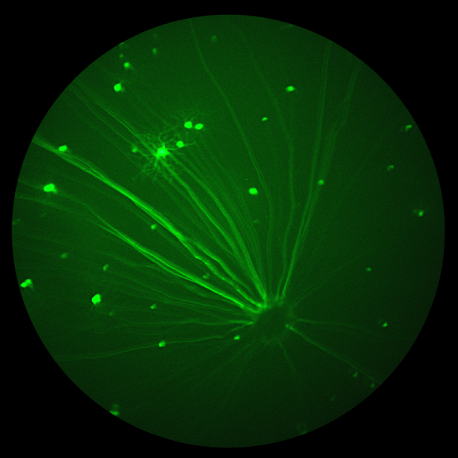
4_GFP

Fluoreszenzbild der Netzhaut von GFP-markierten Ganglienzellen, aufgenommen mit dem MICRON System. Es zeigt helle, diskrete Zellkörper, die über das gesamte Netzhautfeld verstreut sind.

3_CFP

Mit dem MICRON-System aufgenommenes Netzhautbild der Expression von cyan fluoreszierendem Protein (CFP), das die Verteilung des Fluoreszenzsignals in der Netzhaut und entlang der Blutgefäße zeigt.

2_FA

Fluorescein-Angiogramm einer Mäusenetzhaut, aufgenommen in vivo mit dem MICRON System. Es zeigt große und feine Gefäße mit gleichmäßiger Gefäßfüllung und ohne Anzeichen von Leckagen oder Verschlüssen. Die Empfindlichkeit des Systems ermöglicht die Visualisierung des Blutflusses, wobei einzelne Zellen während der Live-Videoaufnahme oft in Bewegung sichtbar sind.

1_Albino

Farbfundusbild der Netzhaut einer BALB/c-Maus, aufgenommen in vivo mit dem MICRON System. Es zeigt eine durchscheinende Netzhaut und sichtbare Aderhautgefäße - Merkmale, die für Albinismus charakteristisch sind.